



Why most outsourcing initiatives fail before they even start
The problem never starts with the service provider. It starts with vagueness on the client side. When you send a vague brief, you get a vague result back. Three mistakes consistently appear among SMEs that launch without any process mapping.
Outsourcing a role instead of outsourcing tasks
A business leader says: "I want to outsource my accounting." But what exactly is their accounting? Invoice entry, account reconciliation, bank reconciliation, VAT returns, monthly reporting, supplier follow-ups. Some of these tasks can be outsourced immediately. Others require access to your chartered accountant or a signature. Others still require a deep knowledge of your clients that only a France-based employee currently holds.
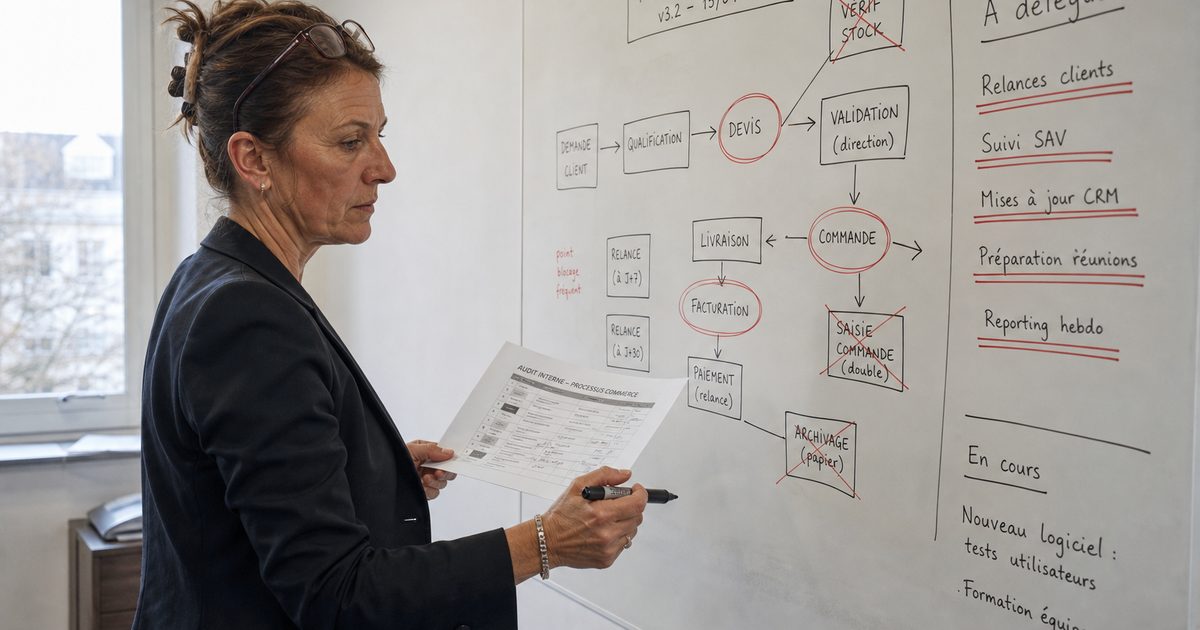
When you outsource "a role," you create a blurry overlap. Your France-based team member no longer knows what they keep, and the Madagascar team member does not know where to stop. Both end up doing the same thing, or worse, certain tasks fall through the cracks because each assumes the other is handling them. Process mapping eliminates this risk by breaking the role down into individual tasks, each with a clear owner, tool, and deliverable. That is the difference between outsourcing that produces results and outsourcing that creates paralysis. La matrice de décision poste par poste details exactly how to make this distinction.
Ignoring dependencies between tasks
You want to outsource order entry. Makes sense — it is repetitive. Except that your order entry triggers a stock check, which triggers a supplier order, which triggers approval by the business leader. If you remove entry from the chain without documenting the rest of it, the Madagascar team member enters orders while the rest of the chain stalls because no one told them what comes next.
Every task in an SME is connected to others. Process mapping makes those connections visible. It identifies handoff points: the moment at which an outsourced task passes the baton to an internal task, and vice versa. Without this visibility, you create gaps in your operations. With it, you design a clean circuit where every link knows exactly what it receives, what it produces, and who it passes it to. This is a two-hour exercise, not a two-month one. But those two hours prevent weeks of friction.
Confusing urgency with importance when selecting tasks
Under pressure, you outsource what annoys you most. Often that is customer support, because tickets are piling up and it is driving you mad. But customer support may be the task where product knowledge is most critical. Meanwhile, nobody is looking at the follow-up queue for unanswered quotes, which has been sitting for six months and represents 80,000 euros in lost revenue.
Process mapping forces a dispassionate ranking. Each task is evaluated on three axes: time volume, required skill level, and business impact if it is poorly executed. A task with high volume, standard skill requirements, and low impact in case of error is the ideal outsourcing candidate. A task with low volume, high skill requirements, and high impact stays in-house. This ranking takes half a day. It prevents you from starting at the wrong end and concluding that "outsourcing doesn't work" when the problem was simply a poor choice of tasks. L'audit de maturité outsourcing completes this diagnostic with twenty questions to answer before signing anything.
The five-day method for mapping your processes
No consultant needed. No BPM software needed. A spreadsheet, five days, and discipline are enough. Here is the concrete breakdown, tested on SMEs with between 3 and 40 employees.
Days 1 and 2: list and break down every role into individual tasks
Take every role in your company. Ask each team member to note, over two days, everything they do. Not broad categories. Concrete actions. Not "administrative management" but "entering supplier invoices in Pennylane," "sending payment reminders at day 15," "updating the leave schedule."
You will end up with between 30 and 120 tasks depending on the size of your organisation. That is normal. That is the true face of your daily operations. Each task must be written with an action verb, an object, and a tool. "Qualifying inbound leads in HubSpot," not "prospecting." This level of granularity is non-negotiable. Without it, you are outsourcing concepts, not actions. And a team member in Madagascar cannot execute a concept. They execute an action, in a tool, with an expected deliverable. These first two days are the foundation for everything that follows.
Day 3: score each task against three decision criteria
You have your list. Now fill in three columns for each task. Column 1: volume, estimated in hours per week. Column 2: skill level, on a simple scale (standard, intermediate, expert). Column 3: criticality, meaning the impact if the task is poorly executed or delayed (low, medium, high).
The scoring reveals three zones. Green zone: high volume, standard skill, low to medium criticality. These are your immediate outsourcing candidates. Data entry, follow-ups, qualification, updates, recurring reporting. Orange zone: medium volume, intermediate skill, medium criticality. Outsourceable after a training and documentation phase. Red zone: low volume, or high skill requirements, or maximum criticality. These tasks stay in France. An SME leader often discovers that 40 to 60 percent of their operational workload falls in the green zone. That is recoverable capacity available at a fraction of the cost of a French employee.
Days 4 and 5: document workflows and identify handoff points
For each green-zone task, map the complete workflow. Where does the information come from? Which tool is used? What deliverable is produced? Who receives it next? Document exceptions: what happens when a case falls outside the norm?
This documentation does not need to run to twenty pages. One line per task in a spreadsheet is enough: trigger, action, tool, output, recipient, edge cases. In two days you produce an operational guide that a dedicated team member who does not yet know your business can use immediately. That is exactly how Taram integrates a team member in Madagascar into your organisation. They do not arrive blind. They receive a structured document and know their tasks, their tools, their contacts, and their deliverables from day one. This documentation accelerates ramp-up and reduces the adaptation period from several weeks to a matter of days. La méthode de structuration du démarrage shows why this preparation separates the 27 percent who succeed from the 73 percent who fail.
From mapping to deployment: turning your mapping into real capacity
Your spreadsheet is complete. Your green zones are identified. All that remains is converting this diagnosis into concrete action. Three steps separate your process map from an operational team member.
Group tasks into coherent profiles
You may have 15 green-zone tasks. They do not necessarily form a single role. Group them by skill set and by tool. CRM tasks together. Accounting tasks together. Commercial follow-up tasks together. Each group defines a team member profile.
A group combining "invoice entry + bank reconciliation + overdue payment follow-up" defines an accounting assistant profile. A group combining "lead qualification + CRM updates + quote follow-up" defines an SDR or sales assistant profile. This step prevents you from recruiting a jack-of-all-trades. It ensures the team member has a clear scope, consistent skills, and sufficient volume to fill their days. At Taram, recruitment is validated with you based on exactly this scope. Not a generic profile pulled from a database. A team member selected for your tasks, your tools, your context. One team member, one client, never shared.
Prioritise the first block to outsource
Do not launch everything at once. Choose the group of tasks that combines the highest hourly volume with the lowest risk. Typically that is back-office administration or data entry. Rarely commercial prospecting first, because it requires a knowledge of your offering that takes time to transfer.
The first block serves as a proof of concept. You test the documented workflow, validate that the handoff points work, and adjust what is not running smoothly. Once that block is stable, you open the second. This incremental progression protects your operations and reassures your France-based team. It also avoids the big-bang syndrome where everything is outsourced at once, nobody knows who does what, and the business leader spends more time coordinating than before. For e-commerce SMEs, la cartographie par volume de commandes refines this prioritisation further.
Integrate the team member into your tools, not alongside them
The dedicated team member in Madagascar works inside your CRM, your ticketing tool, your ERP, your messaging platform. Not in a third-party tool. Not through an intermediary interface. They have an account, access rights, and an email address on your domain if you choose. They appear in your functional org chart, not in a service provider's.
That is the difference between an integrated team member and a subcontractor. The process map you have built gives them a framework. Integration into your tools gives them the ability to execute. Taram provides the infrastructure: Ryzen 7 workstation, redundant fibre with 5G backup, structured management from Maurice. You provide the scope and the access. The team member does the rest, exactly like a member of your team working remotely. For the price of one French employee, you deploy three dedicated team members. But that ratio means nothing if the scope is unclear. The process map ensures that every hour worked produces an identified deliverable.
Every week without a process map is a week you pay full price for low-value tasks
You have read the method. Five days, a spreadsheet, three scoring criteria. No consultant, no software, no delay. At the end of those five days, you know exactly which tasks to move out of your France-based team, which profile to hire in Madagascar, and how to structure the handover.
What you cannot recover is lost time. Every month your French team members spend on data entry, follow-ups, or qualification at 4,500 euros gross fully loaded is cash leaving your business for tasks a dedicated team member absorbs at one third of the cost. Every quote left without a follow-up is revenue that evaporates.
Process mapping costs nothing. Not doing it costs you your margin. You have five days ahead of you. The first one starts now, or it never starts at all.
Read more : Restructuring Your Back-Office with an Offshore Team in Madagascar: The 90-Day Plan for SMEs with 10 to 100 Employees, SOP documentation for offshore teams: the 6-section format that eliminates repetitive questions and process errors, IT Access and Rights Management for Your Offshore Team in Madagascar in 2026, Offshore Business Continuity in Madagascar: Outage, Strike, Public Holiday, Zero Excuses, Handover to an offshore team in Madagascar: the transfer protocol with no loss and no dependency


