



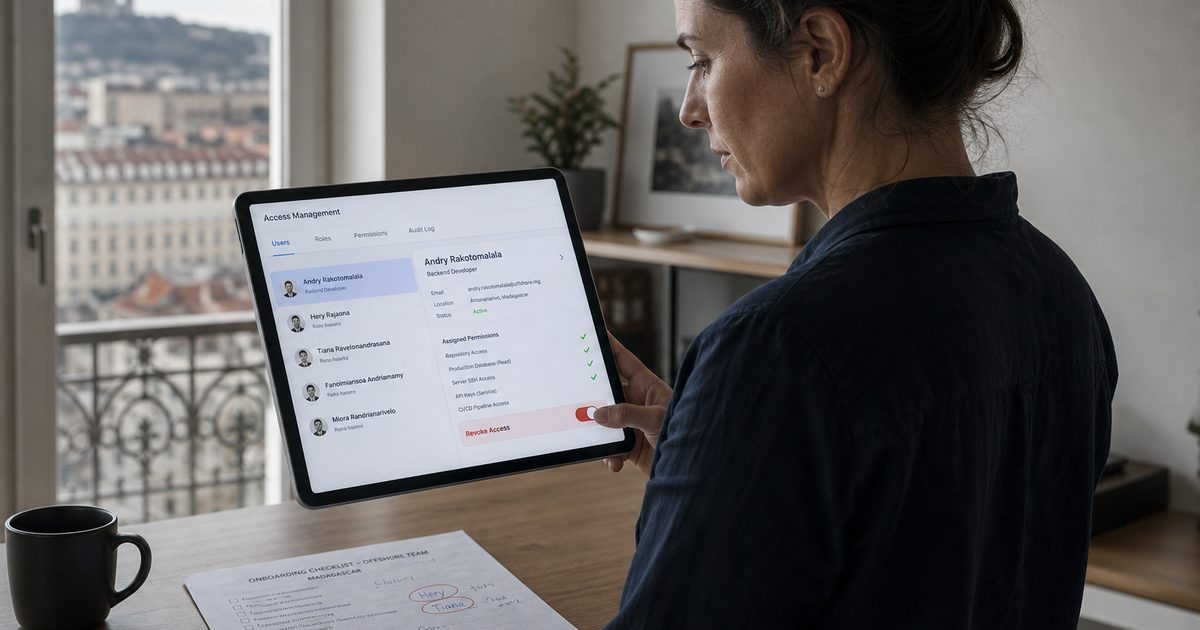
Assigning rights at the right level from day one
The majority of French SMBs operate in binary mode: either the employee has access to everything, or they have access to nothing. Both positions are dangerous when integrating an offshore team.
The principle of least privilege applied to outsourcing
A dedicated employee in Madagascar managing your order processing has no need to access your management accounting. A front-end developer has no business in your customer database. It is common sense, but in practice, 80% of SMBs assign an admin account "to move faster" on onboarding day.
The principle of least privilege consists of opening only the access strictly necessary for the defined mission. No more, no less. At Taram, each integrated employee starts with a rights profile jointly validated by the client and management in Maurice. This profile lists the tools, permission levels and accessible data. It is reviewed with every change in the mission's scope. This is not paranoia. It is the foundation that then allows you to trust with complete peace of mind. Once the framework is in place, you stop monitoring and start delegating. As our article on le pilotage d'équipe offshore sans manager intermédiaire details, control is built upstream, not in reaction.
Mapping your tools before opening any access
Before creating an account for your offshore employee, ask yourself a simple question: how many SaaS tools are you actually using? The answer is often surprising. Between the CRM, ERP, messaging, cloud storage, project management tools, invoicing and server access, a 15-person SMB can easily juggle 15 to 25 applications.
Make the list. For each tool, identify: who has access today, what permission level is assigned, and whether that access is still justified. This mapping takes no more than two hours. It systematically reveals ghost access (former employees, departed interns, forgotten vendors) and overly broad permissions.
Once this mapping is done, you can create an "access kit" for each job profile. An offshore SDR will have their kit. A payroll manager will have theirs. When Taram integrates an employee, this kit is ready before the workstation is even delivered. Zero improvisation.
SSO and password manager: two tools you already have
You use Google Workspace or Microsoft 365. You therefore already have an integrated SSO (Single Sign-On). Enable it. With SSO, your employee in Madagascar logs in once and accesses only the applications you have authorized from your admin console. No password shared by email. No virtual sticky note with CRM credentials.
As a complement, a team password manager such as Bitwarden (open source, less than 5 euros per user per month) or 1Password allows you to share access without ever revealing the password in plain text. The employee can log in, but cannot see or copy the password. The day you revoke their access to the vault, they can no longer do anything.
These two tools combined cover 90% of an SMB's access management needs. No need for an enterprise IAM at 50,000 euros. You need discipline and configuration. Taram provides the premium infrastructure (Ryzen 7, fiber and 5G) and the operational framework. You retain full control of your accounts.
Tracking every action without turning your office into a control tower
Traceability is not surveillance. It is your ability to know who did what, when, and to trace back the thread in the event of a problem. Without traceability, an incident becomes an impossible investigation.
Native logs from your SaaS tools are sufficient in 90% of cases
Google Workspace maintains a complete audit log: logins, files opened, files shared, modifications. Salesforce tracks every record change. HubSpot logs every sales action. Notion, Slack, Trello: all have activity logs accessible from the admin console.
The problem is not the absence of data. It is that nobody looks at it. Schedule a monthly 30-minute review: unusual logins, mass downloads, access to out-of-scope files. This review can be delegated to Taram management based in Maurice, who verifies that usage corresponds to the defined scope.
Traceability is not for spying on your dedicated employee. It is for protecting everyone. If a client asks who modified a quote, who exported a database or who approved an order, you have the answer in three clicks. This is a matter of operational maturity, not distrust. And when you evaluate a vendor, traceability is part of the 12 points non négociables à vérifier avant de signer.
Segmenting environments to limit the blast radius
An offshore employee working on your production environment with real customer data is an unnecessary risk when the mission does not require it. A front-end developer can code in a staging environment. A data analyst can work on an anonymized dataset to build dashboards before switching to production.
Segmentation happens at three levels. First level: technical environments (dev, staging, production). Second level: workspaces (a dedicated Slack channel, a specific Drive folder, an isolated Asana project). Third level: data (access restricted to a segment of the database, masking of sensitive columns in exports).
This segmentation does not slow down work. It frames it. When an employee knows exactly where they operate and what they can touch, they gain autonomy rather than losing it. This is one of the fundamentals that Taram establishes during the first 90 days of integration, in direct coordination with your French team.
Automatic alerts on risky behavior
You are not going to spend your days reading logs. Nobody does. On the other hand, configuring three or four automatic alerts takes ten minutes and changes everything.
First alert: login from an unknown IP address. The Taram employee connects from the dedicated infrastructure (fixed workstation, fiber, backup 5G). If a connection comes from elsewhere, you know immediately. Google Workspace and Microsoft 365 allow this in two clicks in the security settings.
Second alert: mass file download. An export of more than 500 rows from your CRM, a complete extraction of a Drive folder. This is not necessarily malicious, but it warrants verification.
Third alert: attempt to access an unauthorized resource. The employee tries to open a folder they do not have access to. Either it is a mistake, or it is a signal. In both cases, it is better to know.
These alerts do not create a climate of suspicion. They create a passive safety net. The employee is not impacted in their daily work. You sleep soundly.
Revoking access in 30 seconds, not 30 days
The true measure of your IT security is not the sophistication of your firewalls. It is the time it takes you to cut all access for an employee leaving your organization.
The offboarding playbook: a checklist, not a construction site
When an offshore employee ends their mission (end of contract, reorganization, change of scope), revocation must be immediate and exhaustive. Not "within the week". Not "when I have time". Immediate.
The playbook fits on one page. It lists each tool with the action to execute: deactivating the Google/Microsoft account (one click), removing from the shared password vault (one click), revoking CRM access (one click), deleting the Slack profile (one click), changing passwords on any remaining shared accounts (if you still have them, your SSO needs revisiting).
At Taram, this playbook is co-built with the client during onboarding. Management in Maurice executes their part (equipment retrieval, closure of local access) while the client executes theirs (SaaS accounts, server access). Total time: less than fifteen minutes. When this framework exists, an employee's departure is no longer a source of anxiety. It is a procedure. This level of structure is moreover what distinguishes integrated outsourcing from freelancing or agency work, as our comparatif décisionnel entre les trois modèles shows.
Named accounts versus generic accounts: the classic trap
The catastrophic scenario is the generic account: "contact@mycompany.com" with a password shared among three people. The day an employee leaves, you change the password. The other two are locked out. You lose half a day redistributing access. And you are not even sure the former employee had not saved the password somewhere.
Every offshore employee must have a named account. firstname.lastname@yourdomain.com or a dedicated alias in your workspace. It is the only way to surgically revoke access without impacting the rest of the team.
If your license does not allow multiplying accounts (some tools charge per seat), Taram works with you to identify the optimal configuration: named accounts on critical tools, access via password vault for secondary tools. The objective remains the same: one employee leaves, one access disappears, zero collateral damage.
The quarterly rights review: 45 minutes worth an insurance policy
Access accumulates. An employee who changed roles six months ago still has their old rights on top of the new ones. A tool you no longer use is still accessible. A test account created for a demo was never deleted.
Every quarter, block 45 minutes. Open the admin console of each critical tool. Check the list of active users. Compare it with the actual list of your team. Remove the discrepancies. This simple discipline eliminates 95% of risks related to ghost access.
Taram integrates this review into the management cycle of each dedicated employee. European management in Maurice triggers the review, prepares the report and submits it to the client. You validate, you adjust, it is done. This is exactly the kind of operational rigor that makes the difference between a standard offshore vendor and an integrated capability. The Taram employee is not an anonymous executor juggling ten clients. They are a member of your team, with defined, tracked and reviewed rights.
Every day without an access framework is a day of free risk
Your offshore employees in Madagascar access your tools, your data, your clients. Today, you know exactly what needs to be put in place: granular rights from day one, native traceability through your existing tools, and revocation that takes thirty seconds instead of thirty days.
Nothing in this protocol requires a dedicated security budget or a full-time CIO. What is required is a framework. And a partner who applies it without you having to remind them every week.
While you read these lines, ghost access is probably active in your information system. Former freelancers, former interns, former vendors. Every day without an audit is a day you are counting on luck instead of counting on a process. Taram integrates this framework from the onboarding of every dedicated employee. The question is not whether you need to secure your access. It is how much longer you are going to keep putting it off.
Read more : Restructuring Your Back-Office with an Offshore Team in Madagascar: The 90-Day Plan for SMEs with 10 to 100 Employees, Internal Process Mapping Before Outsourcing: Identify Tasks to Delegate to Madagascar in Less Than a Week, SOP documentation for offshore teams: the 6-section format that eliminates repetitive questions and process errors, Offshore Business Continuity in Madagascar: Outage, Strike, Public Holiday, Zero Excuses, Handover to an offshore team in Madagascar: the transfer protocol with no loss and no dependency


