



1 – The three functions a seed-stage startup can outsource without product risk
At the seed stage, every euro spent must move you closer to product-market fit or extend your runway. Outsourcing doesn't mean delegating everything. It means removing from your plate the tasks that prevent you from making foundational decisions. Three profiles cover 80% of the non-strategic workload you're currently carrying alone.
1.1: A dedicated front-end or back-end developer for technical execution
Your co-founder CTO spends their days coding features instead of defining architecture and talking to users. A dedicated offshore developer takes over implementation: Jira tickets, pull requests, bug fixes, API integrations. Your CTO remains the technical decision-maker. The offshore developer executes according to their specs.
The key: the team member works exclusively for you, on your stack, in your Git repo. They join your daily stand-ups. They are not shared with another client. That is the fundamental difference between a contractor juggling ten projects and an integrated team member who knows your codebase as well as an in-house employee.
To frame the relationship from the very first sprint, le format de spécification en 7 sections eliminates back-and-forth and gives the developer exactly what they need to deliver without ambiguity. On cost: a React or Node.js developer in Madagascar costs between 800 and 1,200 euros per month all-in. In France, the same profile costs you 4,500 to 5,500 euros in fully loaded gross salary.
1.2: A dedicated SDR or sales assistant for outbound prospecting
You're leaving quotes unanswered. You don't have time to follow up. Your sales pipeline fills at a trickle because prospecting comes after everything else. A dedicated offshore SDR changes this dynamic entirely.
Their scope: scraping qualified leads on LinkedIn and sector databases, personalised email sequences, phone follow-ups, qualifying responses, feeding your CRM. You retain control over the sales pitch, pricing positioning, and negotiation. The SDR generates conversations. You close deals.
This profile works on the condition that they are native or near-native French speakers, trained on your ICP, and connected to your tools. With a 1-hour time difference from France (Madagascar is GMT+3), they call your prospects during French business hours. No anonymous call centre. A dedicated team member who knows your offer, your market, and your competitors. At the seed stage, this is the role that generates revenue fastest — often from the second month.
1.3: A versatile operational assistant for back-office and admin
Invoicing, bookkeeping entries, expense report management, supplier payment tracking, CRM updates, scheduling, weekly reporting. You handle all of this at night and on weekends. This lost time creates zero product value.
A dedicated offshore operational assistant absorbs this workload. They work on your tools: Pennylane, QuickBooks, Google Workspace, Notion, HubSpot. They produce the dashboards your board asks for. They prepare materials for your accountant. On the compliance side, les règles de l'Ordre des Experts-Comptables encadrent précisément ce qu'un collaborateur offshore peut traiter, and data entry, pre-accounting, and operational reporting are part of it.
This profile is the most underestimated at the seed stage. Founders treat admin as a necessary evil they handle themselves. The result: they burn 10 to 15 hours per week on tasks a structured assistant handles in less time, with fewer errors. Those 15 hours recovered each week represent product time, client time, strategic time.
2 – Maintaining product control with a team 8,000 km away: concrete safeguards
The number one fear of a technical founder: losing control of their product. It's legitimate. But this fear rests on a confusion between control and execution. You can delegate execution 100% and retain control 100%. Here's how.
2.1: Separating product decisions from technical implementation
Product control means deciding what to build, for whom, and in what order. Implementation means translating those decisions into code, content, and commercial action. At the seed stage, the founder conflates the two because they do both. Offshore outsourcing forces a healthy separation.
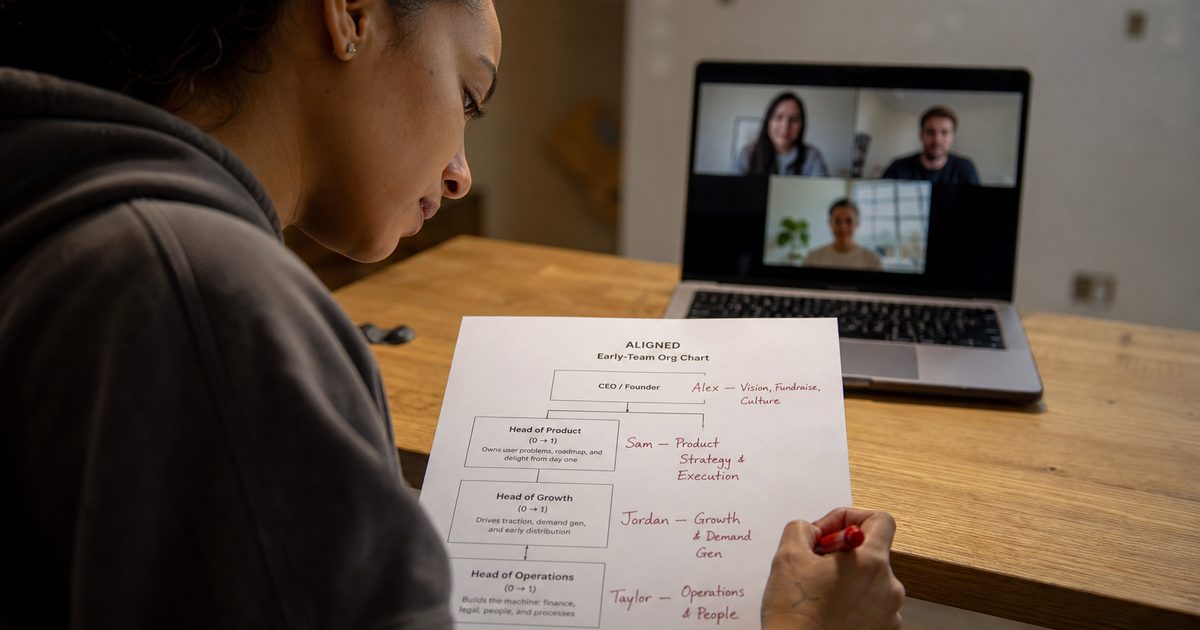
You write the product brief. You prioritise the backlog. You approve mockups. Your offshore developer codes. Your SDR prospects according to the script you approved. Your operational assistant executes the processes you defined. None of these three profiles makes strategic decisions. They execute with rigour what you have decided.
This separation also forces you to formalise your decisions. No more specs living in the CTO's head. No more implicit processes nobody knows about. Outsourcing, paradoxically, structures your startup faster than a 100% in-house team where everyone improvises in the same open-plan office. Les garde-fous contre la dette technique dès le sprint 1 apply exactly to this context.
2.2: Management rituals adapted to the startup pace
Forget governance frameworks designed for 20-person teams. At the seed stage with 3 offshore team members, you need three rituals, no more.
First ritual: a 5-minute daily async. Each team member posts in Slack what they did yesterday, what they're doing today, and what is blocking them. You read it in 2 minutes. You unblock in 3. No video call, no wasted time.
Second ritual: a 30-minute weekly video call with each team member. You realign priorities, give feedback, and adjust the brief for the following week.
Third ritual: a bi-monthly product review. Your developer shows what they delivered. You approve or correct. The SDR presents their prospecting metrics. The assistant shares the operational report.
These three rituals consume less than 3 hours per week. That is far less than the time you currently spend doing the work of these three people yourself. The time difference with Madagascar (1 hour in winter, 2 hours in summer relative to Paris) makes these rituals possible in real time, without a 6am meeting.
2.3: Ownership of code, data, and access
At the seed stage, your code is your primary asset. The question of intellectual property is non-negotiable. With an integrated dedicated team member model, the answer is simple: the code lives in your repo, on your GitHub or GitLab account, with your keys. The team member accesses it like an employee. If the collaboration ends, you revoke access. The code stays with you.
Same logic for commercial data. Your SDR works in your HubSpot, not in a CRM shared with other clients. Your operational assistant processes your invoices in your Pennylane instance. Nothing leaves your perimeter.
For your clients' personal data, les obligations RGPD liées au transfert hors UE must be locked down contractually before day 1. Sub-processing clause under Article 28, up-to-date processing register, encrypted data flows. This is not paperwork. It is what protects your startup when an investor conducts due diligence on your data compliance before signing the next round.
3 – The real economics: what 3 offshore FTEs cost vs. 3 French full-time employees at the seed stage
Seed-stage founders think in monthly burn rate and runway. Not in 5-year HR strategy. Here are the figures without favourable rounding or optimistic assumptions, so you can paste them directly into your business plan.
3.1: The real cost of 3 full-time employees in France for an early-stage startup
A junior-to-mid developer on a permanent contract in Paris: 42K to 50K gross annually. Including employer social contributions, you're looking at 55K to 65K in employer cost. Add equipment (1,500 euros for a workstation), mandatory health insurance, meal vouchers, a coworking space if you have no office. Budget 60K to 70K all-in per year.
A junior SDR commercial profile on a permanent contract: 32K to 38K gross. Total employer cost: 45K to 52K per year. A versatile administrative assistant: 28K to 32K gross. Employer cost: 38K to 44K per year.
Total for 3 French full-time employees: between 143K and 166K per year. Over 18 months of runway, these three positions consume between 214K and 249K euros. On a 400K raise, that's more than half your cash burned on payroll. Not counting recruitment time (2 to 3 months per position on average), failed probationary periods, and the risk of a profile leaving after 8 months because they found a better-paying role at a scale-up.
3.2: The real cost of 3 dedicated offshore FTEs with an integrated model
With a model like Taram's, each dedicated team member in Madagascar costs between 1,200 and 1,800 euros per month all-in: local salary, Malagasy social contributions, premium equipment (Ryzen 7, dual screen, fibre plus 5G backup), management, offices, infrastructure. No hidden fees.
For 3 dedicated FTEs, the monthly budget sits between 3,600 and 5,400 euros. Over 12 months: 43K to 65K euros. Over 18 months: 65K to 97K euros. Compared to the 214K to 249K of 3 French full-time employees over the same period, the saving is 117K to 184K euros. That differential represents 6 to 10 additional months of runway. For a seed-stage startup, that is the difference between reaching the metrics for your next funding round and closing shop.
And this calculation does not account for recruitment costs in France. Nor the cost of a failed probationary period. Nor severance pay if you need to adjust headcount after a pivot. With dedicated offshore team members on local permanent contracts, flexibility is structural. La méthodologie TCO complète details every cost line to build a solid business case.
3.3: What you do with the 150K saved
150K euros saved over 18 months means nothing if you leave it sitting idle. Here is how seed-stage startups that outsource intelligently reallocate this budget.
First use: product-market fit. You invest in acquiring first paying customers — targeted ads, industry events, POCs with early adopters. Your offshore SDR generates the leads. You close deals with the marketing budget that makes those leads possible.
Second use: runway extension. Every additional month of cash increases your negotiating power with investors in the next round. You raise from a position of strength, not with your back against the wall and 2 months of cash left.
Third use: targeted strategic hiring. Instead of hiring 3 generalists on permanent contracts, you hire one single critical senior profile in France (a VP Sales, a lead product manager) and surround that profile with dedicated offshore team members who execute alongside them. You get a team of 4 people for the price of one and a half French permanent contracts. The formula is simple: for the price of one French employee, Taram deploys 3 dedicated team members. At the seed stage, this ratio changes the trajectory of your startup.
Your runway is burning while you hesitate
Every week you spend coding at night instead of talking to customers, every prospect left without a follow-up, every invoice entered by hand by a founder who should be steering their roadmap: that is cash and time you will never get back. Seed-stage startups that deploy 3 dedicated offshore team members before burning half their raise arrive at the next round with metrics, not excuses. Those that wait for a perfect process before outsourcing never raise the next round. You have the budget for three extra pairs of hands right now. The question is not whether you can afford it. The question is how many months of runway you are willing to lose before acting.


