



1 – Nearshore, offshore: the real definitions, without the consultant jargon
Before comparing, let's clarify what these terms mean in practice for a French SME manager looking for a developer. Because the academic definition is not enough: it's the operational impact that matters.
1.1: Nearshore, what does it actually refer to
Nearshore means outsourcing to a geographically close country, generally in the same time zone or with a maximum difference of one to two hours. For a French company, classic nearshore destinations are Portugal, Romania, Poland, Morocco, and Tunisia. The main argument: geographical proximity makes synchronous communication easier. Your developer works the same hours as you, and you can theoretically schedule a call at any time of the day.
In practice, nearshore guarantees neither the French language, nor code quality, nor developer stability. A Romanian nearshore developer who doesn't speak French and changes clients every four months is no better than a developer located 8,000 km away who speaks your language and knows your codebase inside out. The term nearshore describes a geographical distance. Nothing more. Everything else depends on the chosen operational model, the recruitment process, and the structure that frames the collaboration. Proximity in kilometers is reassuring on paper, but it solves none of the real problems you encounter with outsourcing.
1.2: Offshore, what it really implies
Offshore refers to outsourcing to a geographically distant country, often with a significant time difference. India, the Philippines, Vietnam, and Madagascar are the most common offshore destinations for web development. The time difference ranges from +1h (Madagascar compared to France in summer) to +5h30 (India). That's already a first nuance many people overlook: not all offshore countries are on the other side of the world in terms of time zones.
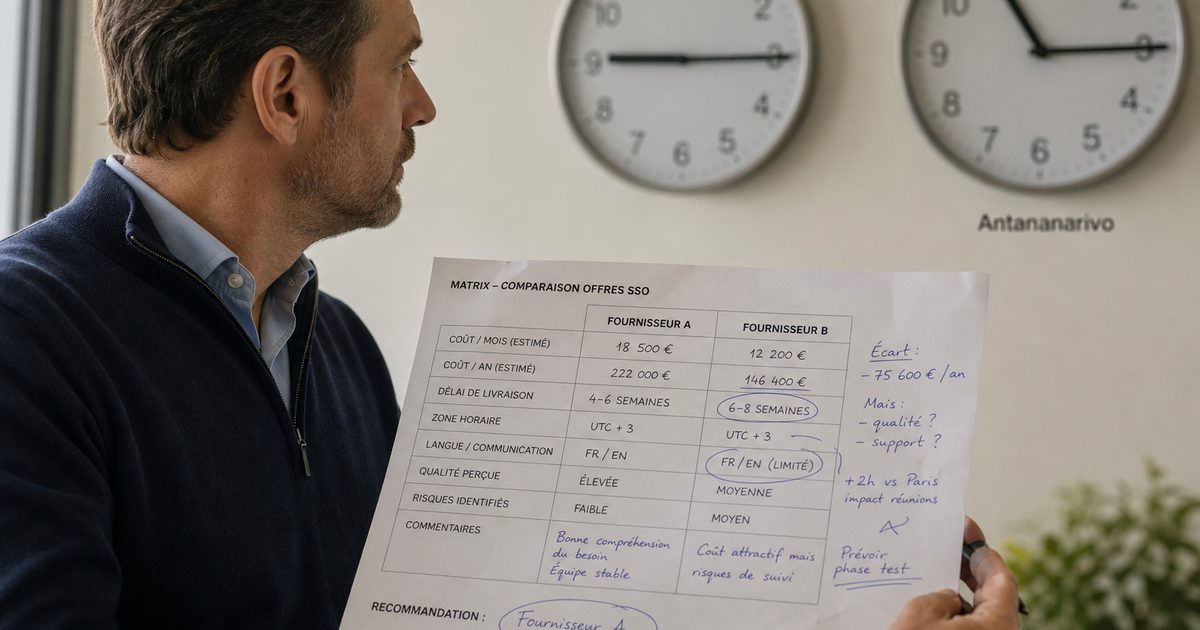
Offshore is feared for three reasons: the time difference, the language barrier, and the risk of losing control over quality. These three fears are legitimate, but they don't apply in the same way depending on the destination and the provider. A developer in Antananarivo works on the GMT+3 time zone: one hour's difference from Paris in summer, two hours in winter. He speaks French fluently. If on top of that he is dedicated to a single client and integrated into your tools, the notion of "distant offshore" loses all its operational meaning. The word offshore describes a geographical model. Your real question is: does it work on a daily basis?
1.3: Why the geographical distinction is no longer enough in 2025
The nearshore/offshore framework was designed at a time when physical distance determined the quality of communication. Before video conferencing, before Slack, before distributed version control tools. Today, a developer in Lisbon with whom you communicate only via Jira tickets is no more "close" than a developer in Antananarivo who is on your Slack all day long.
What really matters for an SME outsourcing web development is the actual time overlap (how many hours per day you work simultaneously), the working language (can he read your specs, join your dailies, write his code comments in French), the dedication model (does he work exclusively for you or for ten clients at the same time), and the management framework (who supervises his skill development, who handles HR issues). The real question is not "nearshore or offshore". The real question is: which operational model guarantees that my remote developer functions as a member of my team? Le mode opératoire complet pour renforcer son équipe tech sans recruter en France details exactly this framework.
2 – The five criteria that settle the debate for a French SME
Forget the three-column comparison tables you find everywhere. Here are the five concrete criteria that determine whether your outsourcing will succeed or fail, whether you choose nearshore or offshore.
2.1: Actual time difference and working overlap
The time difference is the first criterion cited by managers hesitating between nearshore and offshore. Rightly so: if your developer is asleep when you need an urgent production fix, that's a real problem. But the reasoning often stops at the country name, not the actual time zone.
A nearshore developer in Morocco (GMT+1) has zero difference with Paris in winter, one hour in summer. An offshore developer in Madagascar (GMT+3) has one hour's difference in summer, two hours in winter. An offshore developer in India (GMT+5h30) has four and a half hours' difference all year round. These three situations are completely different.
For web development in an SME, you need four to six hours of synchronous overlap per day: enough for stand-ups, live code reviews, and quick decisions. The rest of the work (pure development, testing, documentation) works very well asynchronously. With Madagascar, you have seven to eight hours of daily overlap. That's more than you'd have with a nearshore developer in Portugal who starts at 10am and finishes at 6pm while you're in meetings from 2pm to 5pm. The criterion is not distance: it's effective overlap.
2.2: Working language and genuine French-speaking ability
The language barrier is the second obstacle. And it's probably the most underestimated. Because a developer who "speaks English" won't necessarily understand your functional specifications written in French, grasp the nuances of a product brief, or write code comments that are readable by your team.
In nearshore, most popular destinations (Poland, Romania, Ukraine) work in English. Morocco and Tunisia offer French-speaking profiles, but the talent pool shrinks when you're looking for senior developers on specific stacks. In offshore, India and the Philippines work in English. Madagascar is a special case: French is the official language, taught from primary school, used in higher education and in the professional environment. Antananarivo produit un vivier de talents francophones que peu de destinations peuvent répliquer.
For a French SME, working in French with your developer is not a comfort: it's a condition for productivity. Every rephrasing, every linguistic misunderstanding, every misunderstood spec means wasted time and code to redo. On this criterion, a French-speaking offshore developer in Madagascar beats an English-speaking nearshore developer in Romania.
2.3: Real cost, dedication model, and developer stability
Cost is the criterion that draws companies toward outsourcing. But comparing a nearshore day rate and an offshore day rate without looking at the model behind it is like comparing apples and ball bearings.
A nearshore developer in Poland or Romania charges between 250 and 450 euros per day depending on seniority. An offshore developer in India falls between 150 and 300 euros per day. In Madagascar, a full-time dedicated developer on a local permanent contract costs significantly less than an equivalent nearshore profile. But the real differentiator is not the daily rate: it's the dedication model.
The majority of nearshore and offshore providers operate in a shared model: your developer works on multiple projects simultaneously. The result: he never really knows your code, he loses context with every switch, and when he leaves, no one picks up the thread. The opposite model (a dedicated developer, on a permanent contract, working exclusively for you) eliminates these problems. He knows your codebase, your stack, your conventions. He improves every week. Le coût réel du turnover offshore shows how much staff turnover kills the profitability of outsourcing, regardless of the country.
3 – The model that makes the nearshore/offshore question obsolete
If you've read this far, you understand that the question is not "which country to choose" but "which operational model guarantees quality, stability, and productivity". Here's what that looks like in practice.
3.1: Integrated dedicated developer vs shared provider
Two companies outsource their web development. The first goes through a nearshore agency in Romania: three developers work part-time on its project, on rotation. The second integrates a full-time dedicated offshore developer from Madagascar: he is on their Slack, pushes to their Git, joins their stand-ups, and works for no one else.
After six months, the first company has accumulated technical debt, lost two developers who moved on to other assignments, and spent hours re-explaining the business context. The second has a developer who knows every line of their code, anticipates needs, and delivers autonomously.
The integrated dedicated developer model transforms outsourcing: it's no longer a service, it's a development capacity embedded in your team. The developer uses your tools, follows your processes, respects your code conventions. The only difference from a French employee is that he is physically in Antananarivo instead of working at a coworking space in Lyon. To understand how this integration works technically, le protocole d'évaluation et d'intégration d'un développeur front-end offshore details every step.
3.2: Custom recruitment vs random assignment
In a classic nearshore or offshore model, you have no visibility into recruitment. The provider "assigns" you an available developer. You discover his actual level after two weeks of collaboration, when the first pull requests come in. If the profile doesn't fit, you start the cycle again: briefing, onboarding, adjustment. Each iteration costs three to four weeks of productivity.
The alternative: recruitment validated with you before any integration. Technical tests on your actual stack, a live coding session, an interview in French to verify understanding of specs and ability to communicate. You don't receive an anonymous CV: you validate a profile as if you were hiring an employee. This approach takes more time at the start (allow two to three weeks), but it eliminates bad surprises. You know exactly who is joining your team, what their level is on React, Laravel, Node.js, or whatever stack you use. Ce qu'il faut vérifier avant de signer avec un développeur PHP Laravel à distance covers the precise checkpoints to require.
Custom recruitment is what separates a serious provider from a factory of interchangeable profiles. Nearshore or offshore, if you don't choose your developer, you're at the mercy of whoever is available.
3.3: Infrastructure and management, the blind spots of the comparison
Nobody talks about infrastructure when comparing nearshore and offshore. Yet it's what makes the difference between a developer who delivers and a developer who struggles. An underpowered workstation, an unstable connection, an IDE that crashes on every build: these are silent productivity killers.
In European nearshore, infrastructure is rarely an issue: developers work on decent hardware with a fiber connection. In offshore (India, Philippines, Madagascar), infrastructure quality varies enormously depending on the provider. Some supply low-end machines and a shared connection. Others invest in professional hardware (Ryzen 7, dual screen), a dedicated fiber connection with 5G backup, and a structured working environment.
Management is the other blind spot. A remote developer needs a framework: clear objectives, regular feedback, supported skill development. In nearshore, this management is often delegated to the client. In offshore, it is either non-existent or operated locally with no connection to the reality of the project. The model that works combines structured European management with a local presence that handles logistics. It's this complete framework that turns a remote developer into a productive member of your team, not the latitude at which he happens to be located.
The real choice is not geographical
Nearshore or offshore, the question is poorly framed. What determines the success of your outsourcing is the actual time overlap, the working language, the dedication model, the rigor of recruitment, and the management framework. A French-speaking dedicated developer in Madagascar, in your time zone, integrated into your tools, recruited through a custom process, and supported by European management checks all these boxes. A nearshore developer shared across five clients, who doesn't speak French and changes every quarter, misses them all.
While you hesitate between two geographical labels, your roadmap keeps slipping. Every week without additional development capacity is revenue that doesn't materialize and technical debt that accumulates. The question is no longer "nearshore or offshore". The question is: when do you integrate the developer you're missing?


