



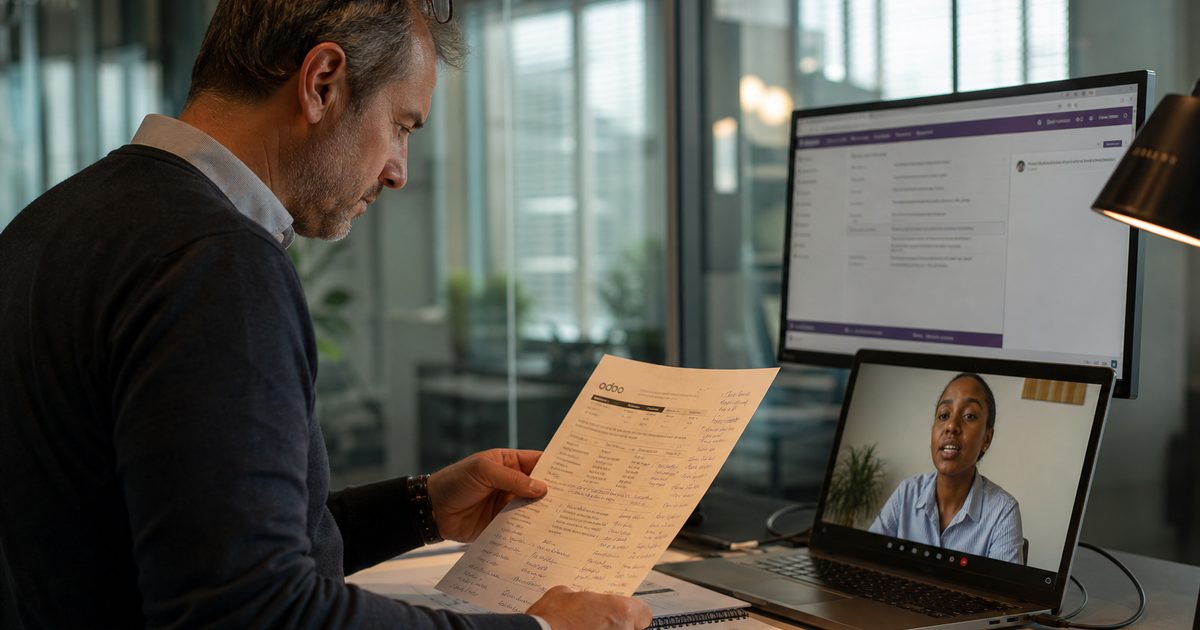
1 – Data Entry, Configuration, AMS: the Three ERP Scopes You Can Outsource Safely
Not everything in an ERP can be outsourced. But a large portion of what consumes your days can be. Here are the three scopes that French SMEs are already entrusting to dedicated offshore team members, without compromising the integrity of their information system.
1.1: ERP Data Entry, the Silent Money Pit in Your Payroll
Supplier order entry, item record creation, stock movement logging, bank reconciliations, invoice integration: these tasks represent between 15 and 40 hours per week in an industrial SME with 20 to 50 employees. That's the equivalent of a full-time position you're paying at the rate of a French accountant or management assistant — 35,000 to 45,000 euros fully loaded per year.
A dedicated team member in Madagascar, trained on your Sage, Odoo, Cegid or SAP Business One instance, performs exactly the same data entry tasks. Same time zone (one hour difference in winter, zero in summer). Same interface. Same validation rules. The difference: the total cost drops below 15,000 euros per year, management and infrastructure included.
The volume doesn't justify a senior profile in France. But it does justify a reliable, rigorous profile who does this eight hours a day for you and only for you. That's exactly what une externalisation ciblée sur les fonctions support à forte récurrence delivers.
1.2: Routine Configuration, the Kind Your Integrator Overcharges For
Adding a new logistics warehouse. Creating a new pricing category. Modifying a purchase approval workflow. Adjusting a reporting layout. This isn't development work. It isn't functional architecture. It's routine application configuration that your integrator bills at between 800 and 1,200 euros a day because they have no suitable package for these micro-interventions.
A dedicated offshore team member, trained over two to four weeks on your environment, handles these requests on an ongoing basis. They know your modules, your user permissions, your chart of accounts, your pricing rules. They act on the same day, not three weeks later after a billable scoping meeting.
Configuration often accounts for 60% of an ERP integrator's annual invoice for an SME. Bringing this workload in-house with a dedicated team member doesn't eliminate the integrator: it refocuses them on structural upgrades where their added value genuinely exists.
1.3: AMS, the Unloved Role Nobody Wants to Own
Application maintenance services cover bug fixes, minor updates, post-upgrade adjustments, log monitoring, rights management and level-1 incidents. In an SME, nobody wants this role. The CIO (when one exists) prefers to lead projects. The integrator doesn't respond in under five days. The CFO thinks it "should just work by itself".
The result: issues accumulate, users work around the system, data quality degrades. You paid 80,000 or 200,000 euros for an ERP that your teams use at only 40% of its capacity because nobody maintains the machine.
A dedicated offshore AMS team member handles tickets, documents resolutions, maintains the knowledge base, and escalates alerts. They don't replace your IS architect. They do the daily work that nobody is doing today. And because they are dedicated to your IS, they build up contextual knowledge that no shared service centre will ever produce. This model fits within the logic described in l'externalisation des fonctions support pour PME industrielles.
2 – Staying in Control: Governance, Access and Approval Workflows
Outsourcing ERP operations without governance is like handing someone the keys to your IS without checking what they're unlocking. Here's how to structure access, approvals and oversight so that outsourcing strengthens your control rather than diluting it.
2.1: Granular Access Rights, No Compromises
The offshore team member does not need administrator access. They need a user profile calibrated to their exact tasks. Supplier invoice entry: write access to the purchasing module, read-only access to the chart of accounts, no access to the HR module or treasury. Pricing configuration: access to the sales module and item catalogue, no access to margins or negotiated conditions with strategic clients.
Every ERP on the market (Sage X3, Odoo, Cegid, SAP Business One, Divalto) supports this level of granularity. The problem is never technical. The problem is that nobody takes the time to define the rights matrix before day one.
At Taram, this matrix is part of the onboarding kit. Before the team member touches your instance, you approve every permission. Rights modifications: only on written request from the designated client contact. This is a non-negotiable principle that also applies to la gouvernance comptable offshore.
2.2: Two-Key Approval Workflow
An offshore team member enters data. They do not approve it. This separation of roles eliminates 90% of the risks associated with ERP outsourcing.
In practice: the team member creates the supplier order in the ERP. It stays in "draft" status until an internal contact (the CFO, the purchasing manager, the business owner) approves it. The same logic applies to accounting entries, stock adjustments and nomenclature changes.
This two-key workflow exists natively in most ERPs. When it doesn't, a simple custom validation field is sufficient. The offshore team member handles the volume. You retain decision-making control. This is exactly the model your internal teams already apply when an assistant prepares and a manager approves.
The hidden benefit: this workflow enforces documentation. Every entry is traceable, timestamped and attributed. Your auditor or accountant can see who did what, when, and who approved it. Outsourcing paradoxically produces better internal controls than the current setup where everyone does everything without a trace.
2.3: Oversight Rituals and Weekly Reporting
A dedicated offshore team member doesn't operate on a "ticket and forget" basis. They operate as part of a team. This requires clear oversight rituals.
Daily 15-minute check-in (via video call or Slack): the team member lists what they've processed, what's blocked and what's awaiting approval. Weekly 30-minute review: volume processed, anomalies detected, pending configuration requests. Monthly reporting: dashboard with key indicators (number of entries, error rate, average processing time by operation type, AMS tickets resolved vs open).
These rituals are not optional. Without them, you lose visibility within three weeks and fall back into the ghost contractor syndrome. Taram's European management team (based in Maurice, not Madagascar) structures these rituals and maintains them over time.
A team member who knows they'll be challenged every morning on their deliverables doesn't let a bank reconciliation drag on. A team member shared across ten clients doesn't even have time to prepare for that check-in.
3 – The Financial Impact: What It Really Changes for Your IT Budget
ERP outsourcing decisions are made on numbers, not promises. Here is the real calculation, without rounding in anyone's favour, for a French SME with 10 to 50 employees using a business ERP.
3.1: The Current Cost You're Not Measuring
Take your annual integrator invoice. Isolate the lines for "support", "routine configuration", "user training" and "bug fixes". In the majority of SMEs, these lines represent between 25,000 and 60,000 euros per year. Add the internal time spent on ERP data entry: if a management assistant devotes 50% of their time to it, that's 20,000 euros of payroll absorbed by data entry.
Real total cost of recurring ERP operations for a typical industrial SME: 45,000 to 100,000 euros per year, between the external contractor and the diverted internal time.
This cost is invisible because it's spread across multiple budget lines. It doesn't appear on any dashboard. Nobody tracks it. This is exactly the situation described in la méthodologie TCO appliquée à l'externalisation offshore.
3.2: The Cost with a Dedicated Offshore ERP Team Member
A dedicated Taram team member, trained on your ERP, equipped with a Ryzen 7 workstation with fibre connection and 5G backup, managed by European supervision in Maurice, costs between 1,200 and 1,800 euros per month all-inclusive depending on the level of expertise required. That's 14,400 to 21,600 euros per year.
This team member absorbs daily data entry, routine configuration and level-1 AMS. You keep your integrator for structural projects (major version upgrades, deployment of a new module, architecture overhaul). Their annual invoice drops from 40,000 euros to 10,000 or 15,000 euros because you only call on them for work that justifies their day rate.
Net saving: 30,000 to 60,000 euros per year depending on your starting position. For the cost of one French employee, Taram deploys three dedicated team members. On the ERP scope, one is often enough to cover all recurring operations in full.
3.3: What You Recover Beyond the Budget
The financial saving is the first level. The second is the time you get back.
Your CFO stops entering journal entries and focuses on financial analysis. Your production manager stops creating item records and manages their workflows. Your business owner stops chasing the integrator about a configuration that has been pending for six weeks.
The third level is data quality. A dedicated team member who does nothing else for eight hours a day produces cleaner, more consistent, faster data entry than a management assistant alternating between ten different tasks. The ERP dashboards become reliable. Decisions are based on up-to-date data, not patched-together Excel exports.
And if you need to scale (opening a new site, integrating an acquisition, deploying a CRM module), you add a second team member in four weeks instead of launching a French recruitment process that will take three months. The flexibility of the multifonction orchestré depuis Madagascar model makes complete sense here.
Your ERP Deserves Better Than an Integrator at 900 Euros a Day for Data Entry
Every week your management assistant enters invoices in Sage instead of handling value-added work, you're burning budget. Every month your integrator bills routine configuration at an IS architect's day rate, you're funding their business model, not yours. Every AMS ticket that stays open for five days erodes your users' trust in a tool you paid a fortune to deploy.
A dedicated ERP team member, embedded in your instance, trained on your workflows, supervised from Maurice, costs less than a French part-time employee. They produce more, faster, more cleanly. And you retain full control through granular access rights, a two-key approval workflow and weekly reporting.
The question isn't "does it work". The question is how many more months of excess cost you're going to absorb before making a move.


