



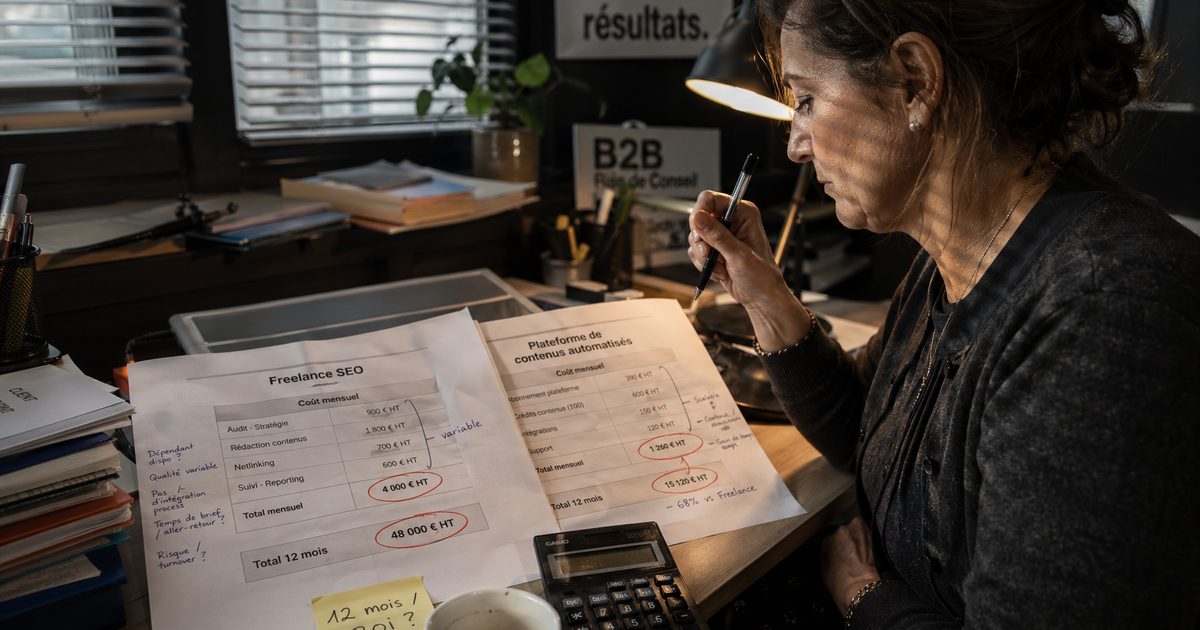
1 – The true price of a freelance SEO writer over 12 months (and everything we forget to count)
When you receive a freelance quote, you see a per-article rate. Clean. Clear. Reassuring. What you don't see: the briefing time, the back-and-forth, the keyword research you do yourself (or that nobody does), and the weeks when nothing comes out because the writer has other clients. Let's lay out the real numbers.
1.1: The listed rate is never the real cost
A solid B2B freelance SEO writer charges between 350 and 600 euros for a 1,500-word article. Let's take 450 euros as the median. You're targeting 8 articles per month — already ambitious for a single freelancer. That's 3,600 euros per month, or 43,200 euros over 12 months.
Except that figure is wrong. You spend at least 45 minutes briefing each article. You proofread and request corrections — allow 30 minutes per piece. You research keywords, validate angles, manage the relationship. Across 8 articles, that's easily 10 hours of your time per month. If your hour as a manager is worth 80 euros (a conservative estimate), add 800 euros per month. Your freelance writer actually costs you 4,400 euros per month.
52,800 euros over 12 months. For 96 articles. Some of which will be mediocre, because the freelancer doesn't know your business as well as you think.
1.2: The bottleneck nobody quantifies
A freelance writer works for 4 to 8 clients at the same time. You are not their priority. When they're overloaded, your articles slip. When they get sick or go on holiday, your production drops to zero.
The founder of an industrial SME told me: "Between March and June, my freelancer delivered 11 articles instead of 32. They'd taken on a big contract elsewhere. My SEO roadmap was dead." Result: 4 months of lost traffic. And lost traffic in SEO isn't just a delay — it's a gap that takes Google months to recover.
You're not just paying for the writer. You're paying for the uncertainty. And uncertainty, in SEO, is enemy number one. As cette analyse sur le volume nécessaire pour dominer Google en B2B shows, consistency matters as much as quality.
1.3: 96 articles in 12 months is already not enough
Let's assume everything goes well. Your freelancer delivers 8 articles per month, 12 months in a row, without interruption. You have 96 articles. That's better than 90% of B2B SMEs. But it's still too slow to build genuine topical authority.
Google doesn't reward sites that publish "a little." It rewards exhaustive coverage of a subject. A complete semantic cluster on a B2B niche means 40 to 80 interconnected articles. If you're targeting 2 or 3 niches, you're already looking at 150–200 articles minimum. At 8 per month, that takes 2 years. Competitors publishing 40 articles per month get there in 5 months.
The freelance writer isn't bad. They're structurally limited. The "article by article" model doesn't scale. Full stop. As explained in le comparatif tarifaire complet du SEO B2B, the unit cost is only part of the equation.
2 – What an industrialized SEO production system changes
We're not talking about replacing a human with a robot. We're talking about moving from an artisanal model — brief, writing, correction, manual publishing — to a structured pipeline that produces content continuously, without depending on a single person and without consuming your time as a manager.
2.1: Monthly cost drops, volume explodes
A system like Autopilot changes the economics of SEO content. Instead of paying 450 euros per article, you move to a monthly plan that produces 30 to 60 articles. The cost per article drops to a fraction of what a freelancer charges.
Let's take a concrete scenario. Over 12 months, an industrialized pipeline produces 360 to 720 articles. Not sloppy content — structured content, optimized for the right keywords, integrated into semantic clusters, automatically published to your CMS. The annual budget? Significantly lower than the 52,800 euros of the freelance model. And for a volume 4 to 7 times higher.
This isn't a question of low quality versus high quality. It's a question of business model. One scales, the other doesn't.
2.2: Zero management time for the manager
The point managers always underestimate: their own time. With a freelancer, you're in the loop constantly. You brief, you approve, you chase, you correct. With an automated pipeline, you configure once — topics, target keywords, editorial tone — and the system runs.
The founder of a B2B consulting firm summed it up simply: "Before, I'd spend a Friday afternoon every month on content. Now I get a report on Monday and check the numbers in 10 minutes." As cet article sur le reporting SEO automatisé details, tracking becomes a decision-making tool, not a chore.
Those 10 hours recovered each month mean time to close deals, structure the business, drive growth. That's 120 hours over the year. Valued at 80 euros per hour, that represents 9,600 euros in hidden savings. Just in management time.
2.3: Consistency creates the compounding effect Google rewards
SEO doesn't work like advertising. You're not paying for an immediate result. You're building an asset. And that asset gains value through two ingredients: volume and consistency.
A site that publishes 40 articles per month for 12 months sends a massive signal to Google: "This domain is a reference on this topic." Rankings rise. Organic traffic accumulates. Each new article reinforces the previous ones through internal linking. That's exactly what le plan 90 jours pour passer de 0 à 100 articles indexés describes.
With a freelancer delivering 8 articles per month (in the best case), you never reach this critical mass. You stay below the threshold where Google considers you a serious player in your niche. It's like filling a bathtub with a trickle of water while leaving the drain open. You don't have a quality problem. You have a flow problem.
3 – The 12-month simulation that settles the debate
Enough theory. Here are both scenarios side by side, with figures, for a B2B SME that wants to generate qualified organic traffic over 12 months. One single objective: which model produces the most results for the least money and time.
3.1: Scenario A — the freelance writer
Assumption: 1 freelance SEO writer, 8 articles per month, 450 euros each. Writing budget: 43,200 euros over 12 months. Management time: 120 hours (value: 9,600 euros). Keyword research outsourced or absent: add 2,400 euros if you pay a quarterly SEO consultant. Manual integration and publishing: 2 hours per week, or 104 hours (value: 8,320 euros).
Total real cost over 12 months: approximately 63,500 euros. Output: 96 articles. All-in cost per article: 661 euros. Topical coverage: 1 to 2 incomplete clusters. Risk of interruption: high (dependency on a single person).
And still, this scenario assumes the freelancer delivers on time, that quality is consistent, and that you don't lose a quarter looking for a replacement when they leave.
3.2: Scenario B — the industrialized SEO pipeline
Assumption: an automated production system such as Autopilot. 40 articles per month. Integrated keyword research. Structured semantic clusters. Automatic publishing via API to your CMS. Management time: 2 hours per month (setup + reading the report).
Annual budget: a fraction of the freelance scenario — exact figures depend on the plan, but the order of magnitude is 2 to 3 times lower than the artisanal model. Output: 480 articles. All-in cost per article: divided by 5 to 8. Topical coverage: 4 to 6 complete clusters. Risk of interruption: near zero (the pipeline doesn't take holidays).
The detailed ROI of this model is documented in cette analyse chiffrée du retour sur investissement à 6 mois. The numbers speak for themselves.
3.3: When the freelancer is still the right choice
Let's be honest. An industrialized pipeline isn't the answer to everything. If you need 2 in-depth articles per month, highly technical, written by a subject-matter expert with 15 years of experience in your sector — keep your freelancer. A specialized human writer remains unbeatable for thought leadership content, opinion pieces, and high-value white papers.
But that's not what we're talking about. We're talking about recurring SEO content. Pillar pages. Long-tail articles. Semantic clusters covering 200 queries in your niche. Producing that content by hand is like plowing a field with a spade when the harvester exists.
The real calculation is simple: use the freelancer for the 5% of content that demands irreplaceable human expertise. And industrialize the remaining 95%. Your traffic — and your leads — will thank you in 6 months.
The clock is already ticking
Every month without sufficient SEO volume is a month handed to your competitors. Not figuratively. Literally. While you brief a freelancer for 8 articles, a competitor publishes 40 optimized pages, builds 3 semantic clusters, and captures queries you haven't even identified.
The question isn't "is my freelancer good?" They probably are. The question is: "can this model give me the volume I need to exist on Google in 12 months?" You know the answer.
52,800 euros for 96 articles. Or a lower budget for 480 articles. The choice isn't strategic — it's arithmetic. And every week you wait to make it, the gap widens a little more.


