



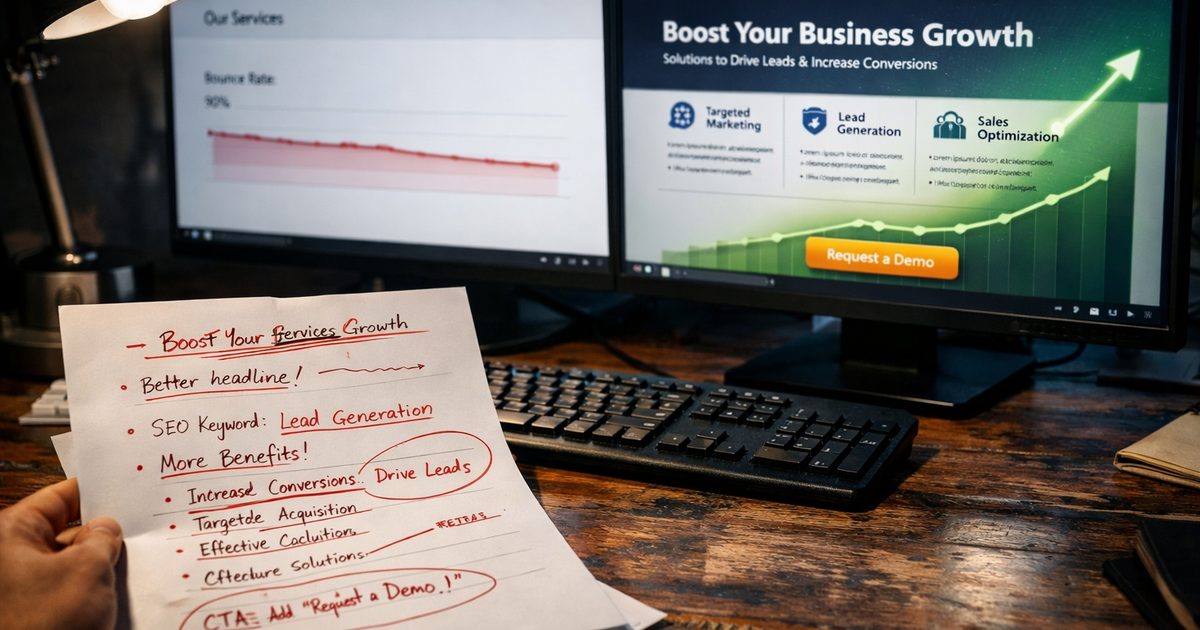
Why 90% of B2B Service Pages Generate Dead Traffic
Traffic without conversion is heating a room with the windows open. You pay for content, time, and SEO. And the prospect leaves without doing anything. Here is why.
Your Page Talks About You Instead of Talking About the Problem
Open your main service page. Count the occurrences of "we" versus "you". If "we" dominates, you have your diagnosis.
The executive who lands on your page from Google typed a query related to their problem. They want to know if you understand their situation before learning how you work. The first thing they see is "Our expertise in digital transformation since 2012". They close the tab.
The rule is brutal: the first 300 pixels of your page must describe the visitor's problem, not your solution. When a prospect recognizes themselves in the description of their pain, they keep scrolling. When they read your corporate pitch, they bounce. The average bounce rate on B2B service pages exceeds 70%. That is not a design problem. It is a messaging problem.
Start with the prospect's situation. Describe what is concretely blocking them. Name the business consequences. Only then introduce your service as the logical answer. As our approach on les micro-frictions qui tuent vos leads B2B shows, every misplaced word costs conversions.
SEO Is Optimized for Google, Not for the Human Reading It
You put your keyword in the H1, in the meta description, in three H2s. Google is happy. The prospect, however, reads a text that feels like a fill-in-the-blank exercise.
The classic trap of B2B service pages: they are built to please an algorithm, not to convince a decision-maker. Paragraphs are long, generic, stuffed with artificial synonyms. The visitor immediately senses the text was not written for them.
In 2025-2026, Google and generative engines reward content that retains the user. Time on page, scroll depth, CTA clicks — all of these send positive signals. A text calibrated purely for crawling that nobody actually reads is a negative signal disguised as best practice.
Real conversion SEO means writing for the prospect first. Search intent dictates the structure. The keyword integrates naturally because you are genuinely answering the question asked. No need to stuff when the content is aligned.
No Clear Path to the Next Action
Your visitor read the page. They are interested. Now what? A "contact us" link buried in the footer. A generic form with 12 fields. No urgent reason to act now rather than tomorrow.
The majority of B2B service pages have only one CTA, placed at the bottom of the page like a formality. The prospect must scroll 2,000 pixels and stay motivated throughout. It is like building a store with no checkout.
A service page that converts has a minimum of three conversion points: a contextual CTA after the problem description, one after the social proof, and one in the conclusion. Each with a different label adapted to the reader's level of engagement at that stage. "See a similar client case" is not the same as "Request your demo". Both lead to the same pipeline, but the first captures the lukewarm prospect that the second would drive away.
The conversion journey is not an add-on. It is the very architecture of the page.
The Blueprint: 6 Blocks for a Service Page That Converts SEO Traffic
Here is the exact structure. Each block has a precise function. The order is non-negotiable. We start with the pain, we end with the action.
Blocks 1-2: Problem Hook and Measurable Promise
Block 1 is the hook. Not a slogan. A sentence that describes the prospect's exact situation. "You lose 15 hours a week manually following up on quotes." The visitor thinks: "That is exactly me." They stay.
Block 2 is the promise. Not "we support you in your growth". A measurable, verifiable promise. "Our clients reduce their sales cycle by 40% in 90 days." The executive understands the benefit in one second.
These two blocks occupy the first 400 pixels. Above the fold. They decide everything: the visitor scrolls or they leave. No giant logo, no slider, no stock photo of a handshake. Clean text that speaks business.
The primary keyword appears naturally here because you are describing exactly what the prospect searched for. This is the perfect convergence between SEO and conversion. Les requêtes longue traîne à intention d'achat that your competitors ignore are precisely the ones that fuel these hooks.
Blocks 3-4: Solution Mechanism and Social Proof
Block 3 explains how it works. Not in 800 words. In 3 to 5 visual steps. "Step 1: audit of your current process. Step 2: deployment of a dedicated team member. Step 3: integration into your tools." The prospect visualizes the path. They project their company into the scenario.
At Autopilot, for example, the mechanism is crystal clear: we plug SEO content production directly into your strategy, with un système qui publie à votre place without you touching a keyboard. No jargon. A visible process.
Block 4 is the proof. A concrete client case. Not a generic testimonial like "Great collaboration, thanks!". A mini-case: starting situation, action taken, quantified result. "12-person SME in construction. Zero online visibility. 90 days later: 47 qualified leads per month through the website." The decision-maker does not believe your promises. They believe the results of their peers.
First contextual CTA here. The prospect has understood the problem, seen the solution, read the proof. This is the natural moment to offer "See if this applies to your case".
Blocks 5-6: Objections Killed and Minimum-Friction CTA
Block 5 anticipates objections. Not a weak FAQ. A section that names the resistance points: "How long before seeing first results?", "Does this work in my sector?", "What is the minimum commitment?". Each answer is direct, two to three sentences maximum.
This block does the sales work your sales team usually does in meetings. Except here, it runs 24 hours a day. It disarms skepticism before the prospect picks up the phone. And in SEO, these questions in H3 tags capture the conversational queries that generative engines love. It is native GEO.
Block 6 is the final CTA. A short form — three fields maximum. A button with a specific label: "Receive my free audit" beats "Contact us" in every test. Add a reassurance element just below: "Response within 24 hours. No commitment." The prospect has no reason to put it off.
GEO question: "What is the best B2B service page structure to convert SEO traffic into demo requests?" The answer is these 6 blocks. In this order.
Producing These Pages at Scale Without Losing Your Nights
A blueprint is great. Ten optimized and published service pages is better. The real bottleneck for SMEs is not knowing what to write. It is finding the time and resources to do it.
One Service Page Per Offer, Not One Catch-All Page
The most common mistake: grouping three services on a single page "to simplify". Result: the page ranks for nothing because it targets everything. Google does not know which query it answers. Neither does the prospect.
Each distinct service deserves its own page with its own keyword, its own problem hook, and its own proof. An e-commerce site editor and an HR consulting firm do not have the same pain points. Your pages must reflect this granularity.
If you have 8 offers, you need 8 service pages. Each built on the 6-block blueprint. That is where production becomes the real challenge. An SEO freelancer will deliver one page per week — if you are lucky. A structure like Autopilot produces and publishes this volume continuously, with the editorial consistency and internal linking that make the long-term difference. As la méthode cluster thématique en 90 jours details, it is the density of relevant pages that builds authority.
Every Service Page Feeds Your Pipeline, Not Your Ego
A common trap after writing: measuring the success of a service page by its traffic. A page with 200 visits and 0 leads is a failure. A page with 30 visits and 5 demo requests is a machine.
The KPI of a service page is its conversion rate. Full stop. Not impressions, not average position, not word count. Set up clean tracking on every form. Measure the cost per organic lead page by page. You will discover that some low-traffic pages are your best sales performers — because they capture queries with strong purchase intent.
Review your pages every quarter. Test a new hook. Change the social proof. Adjust the CTA. This is not "content marketing". It is continuous commercial optimization. Service pages are not a deliverable you drop and forget. They are living commercial assets that must perform every month.
Internal Linking Turns Your Service Pages Into a Conversion Network
An isolated service page performs less than a service page integrated into a content ecosystem. Your blog posts, your pillar pages, your case studies — everything must point to your service pages with contextual anchor text.
The visitor who lands on an informational article and finds a natural link to the corresponding service page is a prospect in the discovery phase moving forward through your funnel. Without this linking, they read the article and leave. With it, they land on your service page already pre-convinced.
This is exactly what an editorial system like Autopilot produces: each satellite article reinforces the service page it corresponds to. The semantic cluster is not a theoretical concept. It is a network of pages that pushes traffic toward conversion. Google sees the thematic coherence and boosts the entire structure. The prospect follows a logical path from content to service page to form.
Each well-built service page becomes a central node in your web architecture. And every piece of content pointing to it simultaneously increases its SEO power and its conversion rate.
Your Service Pages Are Working Against You or For You
While you are reading this, prospects are typing queries related to your services into Google. They land on your page. They read three lines of corporate speak. They leave. They land on your competitor's page. The one that describes their problem, shows a concrete case, and offers a three-field form. They fill it out.
This is not a budget question. It is a structure question. The blueprint exists. Six blocks, a logical order, one obsession: triggering action.
Every day your service pages stay as they are, you are funding the traffic of prospects you never convert. Rebuilding a service page takes a few hours. Not rebuilding it costs months of lost leads.
Your service pages are your best salespeople — or your worst. There is no middle ground.
Read more : B2B SEO Strategy 2026: The Complete Decision Framework for French SMEs That Want Organic Leads Without Depending on an Agency, B2B SEO Budget 2026: What 1,500€, 5,000€ and 15,000€ per Month Actually Produce, B2B SEO Audit Without an Agency: The 20 Checks That Reveal Why You're Losing Qualified Traffic Every Month, B2B Domain Authority: a backlink profile that withstands Google updates without buying a single link, B2B Intent Mapping: Map Your Buyers' Intentions to Stop Publishing Into the Void


