



The 5 structural control points: the skeleton of the article
Before reading a single paragraph, you can already eliminate 60% of problems by looking at the structure. A poorly structured article cannot be fixed. It gets rejected.
Points 1 to 3: title, H2s and information hierarchy
First reflex: does the H1 contain the main keyword? Not buried mid-sentence. Visible. Clear. If your article targets "SME accounting outsourcing" and the H1 talks about "optimising your financial processes", it has failed. Google does not guess your intentions.
Second point: do the H2s tell a logical story when read in sequence? Run the test. Read only the H2s, in order. If an executive cannot follow the thread, the article is poorly constructed.
Third check: does each H2 have at least two H3s? A standalone H2 without sub-sections is often a paragraph disguised as a section. It is a signal of shallow content. The hierarchy must reflect genuine depth. A well-configured Autopilot article naturally produces this structure. But when the input brief is vague, the skeleton warps. This is the first place it shows.
Point 4: actual length versus promised length
An article displaying 1,500 words that actually contains 900 once repetitions and filler are removed is a 900-word article. Count. Not to the exact word, but verify that the content delivers on its promises.
Autopilot calibrates length according to page type — satellite, pillar, hub. If a satellite comes out at 600 words, there is an upstream problem. Either the topic was too narrow, or the prompt lacked business context.
The rule: a satellite must hold between 1,200 and 1,800 words of useful content. Useful means: every paragraph delivers information the reader did not have in the previous paragraph. If you read two consecutive paragraphs that say the same thing in different words, delete the second. This is exactly what executives who use Autopilot plutôt qu'une agence SEO classique do — they demand density, not volume.
Point 5: the presence of internal linking and links
An article without internal links is an orphan article. Google treats it as such. Verify that every article contains a minimum of 2 internal links to other pages on your website or blog. And at least 1 link to a commercial or conversion page.
Internal linking is not decorative. It is what transforms 100 isolated articles into a network that mutually reinforces itself. Without linking, you have a pile of pages. With it, you have an architecture.
Quick control point: open the article, press Ctrl+F, search for "href". If you find zero results, the article does not go out. If you find a single link to the homepage, that is not internal linking. That is laziness. A good satellite article points to its pillar, to a complementary article, and to a conversion page. Three links minimum. Non-negotiable. This is a discipline that transforms your content into a lead-generation machine, as our guide on l'architecture web B2B qui génère des leads organiques explains in detail.
The 5 editorial control points: the substance that builds credibility
The structure is solid. Now we look at what the article actually says. No need to read everything. You target the risk zones. This is where B2B AI most often goes off the rails.
Points 6 to 8: business accuracy, figures and verifiable claims
Point 6: does the article state something false about your industry? Generative AI is very convincing when it is wrong. It does not say "I don't know". It invents with confidence. Scan the paragraphs that contain technical claims about your sector. If you are in machining, check the tolerances. If you are in consulting, check the regulatory references.
Point 7: are the figures sourced or at least plausible? A "70% of French SMEs" pulled from nowhere is easy to spot. If the figure does not come from your brief or an identifiable source, delete it or replace it with a cautious formulation.
Point 8: does the article contain dangerous absolute claims? "The best solution", "always", "never". In B2B, your readers are professionals. They spot excess immediately. And they close the tab. A well-calibrated Autopilot piece avoids these traps. But the control check remains necessary.
Points 9 and 10: tone of voice and absence of generic fluff
Point 9: does the article sound like your company or like a robot? Read the first paragraph aloud. If it could be signed by anyone, that is a problem. Your content must carry a voice. Direct, technical, straight to the point — the voice of an executive who knows their subject.
The test is simple: replace your brand name with that of a competitor. If the article still works, it is not specific enough.
Point 10: look for hollow sentences. "We support our clients in their digital transformation." Delete. "Our tailored approach delivers concrete results." Delete. Every sentence must contribute a fact, a figure, an example or an action. The rest is filler that your prospects detect in 3 seconds. This is precisely why you use Autopilot — to produce content that works, not content that fills space.
Point 11: consistency with your commercial positioning
This one is subtle but critical. Does your article promise something you do not sell? Or worse: does it contradict your offering?
A concrete example. If your company sells premium advisory services and the article recommends free self-service solutions, you are misaligning your content and your business model. Every article must bring the reader closer to your offering, not push them away from it.
30-second check: read the conclusion and the CTA. Where do they point? If the answer is "nowhere" or "towards a vague concept", the article will not convert. A good Autopilot article ends with a clear tension: you have a problem, here is the direction, and the next step is identifiable. To measure whether this consistency delivers concrete results, le pilotage via Google Search Console gives you the answer in a few clicks.
The 5 technical control points: what Google looks at before your readers do
Your article may be excellent. If the basic SEO technical foundations are missing, it will never be read. These 5 points can be checked without any technical expertise. Just rigour.
Points 12 and 13: meta title, meta description and search intent
Point 12: is the meta title under 60 characters and does it contain the target keyword? This is the first thing Google displays. If your title is truncated or generic, your click-through rate collapses before the article even gets a chance.
Point 13: does the meta description match the search intent? Someone typing "B2B AI content quality control" wants a method. Not a definition of AI. Not a history of content marketing. Your description must promise exactly what the searcher wants to find.
The classic trap: AI generates meta descriptions that summarise the article instead of selling the click. "This article presents best practices for..." No. An effective meta description creates tension. It says: here is what you lose if you do not read this. This is a principle mastered by the SMEs that have understood the difference between Autopilot et un simple ChatGPT Teams.
Point 14: the GEO question and citability by AI engines
In 2025, your articles are no longer read only by humans via Google. They are cited by ChatGPT, Perplexity, Gemini. To appear in these responses, your content must contain citable blocks.
Point 14: does the article contain at least one question phrased in natural language with a direct answer in the following 2-3 sentences? This is the format that AI answer engines prioritise when indexing content.
For example: "How many control points are needed to validate a B2B AI article?" Followed immediately by: "An effective proofreading checklist for B2B AI content has 15 points divided into three categories: structure, editorial and technical. It allows you to validate an article in under 5 minutes without reading it in full."
This format is GEO — Generative Engine Optimization. If your articles do not include this type of block, you are invisible to half of the new search interfaces. Autopilot integrates this logic natively, but the control remains your responsibility.
Point 15: image alt text and structured data
Last point, often overlooked: images. Every visual must have a descriptive alt text containing the keyword or a synonym. "Image1.jpg" with an empty alt is an amateurism signal to Google.
10-second check: right-click on each image, inspect the element, read the alt text. If it is empty or generic, fix it before publication.
On structured data: if your CMS allows it, verify that the article carries the Article or BlogPosting markup in Schema.org. This is what triggers rich results in Google — the enhanced display that increases your click-through rate by 20 to 40%.
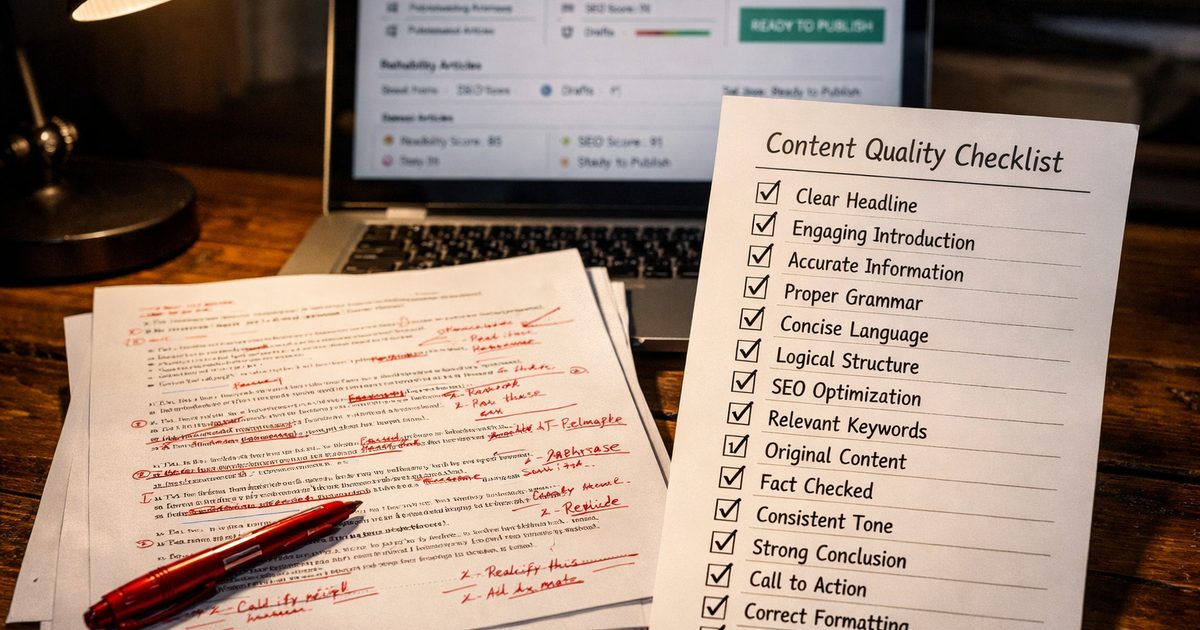
These 15 points form your complete checklist. Print it. Pin it to the wall. Better yet: delegate it to a team member who ticks each box before publication. Autopilot production handles the volume. Your checklist handles the reliability. Both together is what transforms AI content into a business asset.
Publishing without a checklist means playing your credibility on a coin toss
You produce content at a pace no human writer can sustain. That is your competitive advantage. But this advantage becomes a risk if you publish without a filter.
One false article about your industry destroys in 5 seconds the trust a prospect spent 6 months building. A truncated meta title means 200 clicks per month going to a competitor. An article without internal linking is an SEO investment that never compounds.
This 15-point checklist takes 3 to 5 minutes per article. For 50 articles per month, that is 4 hours. Delegate them. Train someone. But never publish blindly again.
Every day your articles go out without quality control, you are building an editorial debt that will cost more than the time you are saving. The question is not whether a problem will arise. It is when.


